
The "Great Correction": Why AI Agents Are About to Break Your Marketing Funnel
The era of "mousetrap marketing" is over. Here is why AI agents will punish your shortcuts and force a return to fundamentals.

For the better part of a decade, digital marketing has felt like a video game we figured out how to cheat.
We found the exploits. We learned that if we jammed enough keywords into the header, Google would rank us. We learned that if we interrupted the user with an interstitial popup the second they landed on the page, we could squeeze out an extra 0.5% conversion rate. We learned to worship the “short-term metric”, the click, the view, the immediate session duration.
We stopped building brands. We started building mousetraps.
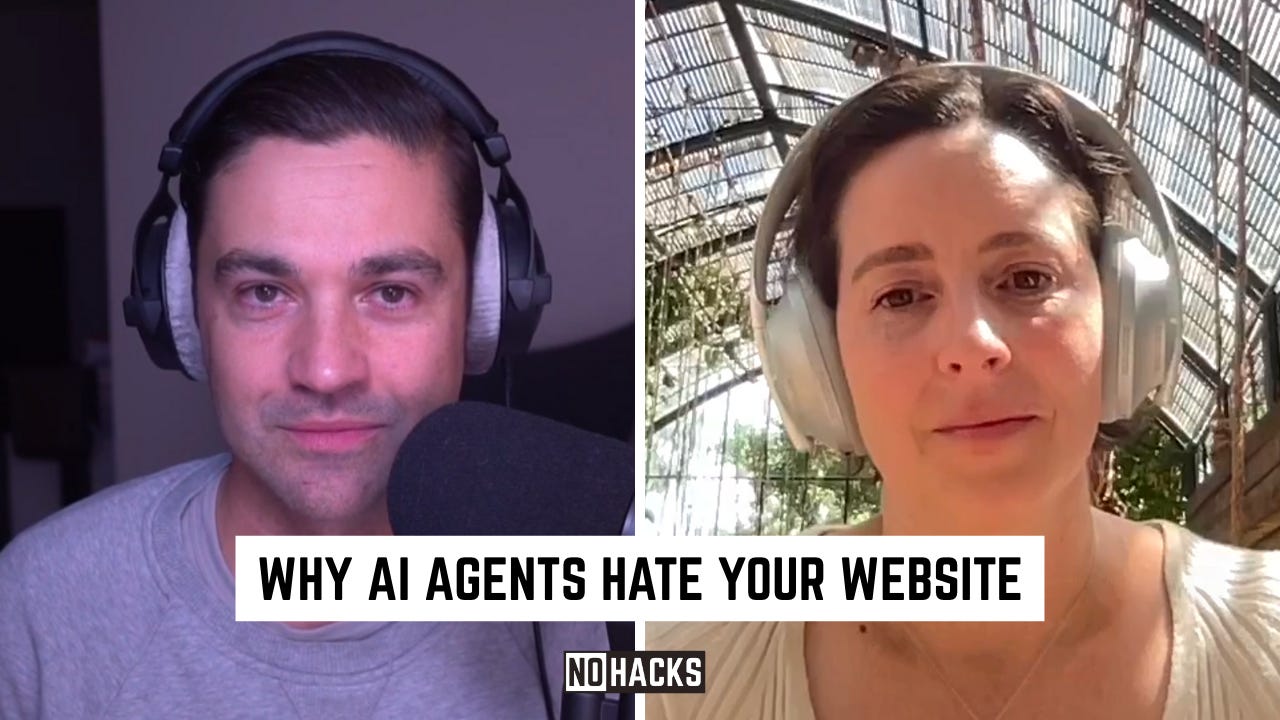
But as I discussed in this week’s episode of the podcast with SEO Futurist Jes Scholz, the era of the mousetrap is over.
We are entering a period of what I’m calling the “Great Correction.”
The catalyst for this correction isn’t a Google algorithm update. It’s a new type of user. One that doesn’t have eyes, doesn’t use a mouse, and crucially has absolutely zero tolerance for our “hacks.”
I’m talking about AI Agents.
The User That Reads Code, Not Pixels
When a human visits your website, they might tolerate a bad experience. They might sigh and close the popup. They might hunt around a confusing menu because they really want the product.
An AI Agent won’t.
Jes Scholz has been running extensive tests on how AI agents (like ChatGPT’s browsing agent) interact with modern websites. The results are a wake-up call for anyone who has prioritized “hacks” over fundamentals.
If your website uses a <span> tag styled to look like a button instead of a semantic <button> tag? The agent can’t “see” it. It fails.
If your site loads a massive interstitial popup? The agent doesn’t look for the “X” button. It sees an obstruction, may assume the site provides no value, and leave immediately.
As Jes put it during our conversation: “This will actually make websites better because all of these things you did to manipulate the humans, a bot doesn’t tolerate.”
We are moving from an era where we optimized for visual persuasion (tricking the human eye) to an era of structural honesty (providing clear, semantic data to a machine).
The “Tech Bro” Trap (and Why It Will Destroy You)
Of course, old habits die hard. As we transition to this AI-first world, the instinct for many is to find the new hack.
Right now, the popular “playbook” floating around Twitter/X is to use AI bots to spam Reddit threads. The logic goes like this:
LLMs train on Reddit data. If I flood Reddit with comments saying my product is great, the AI will learn that my product is great.
Let me be clear: This is the fastest way to destroy your brand in 2026.
Jes went on an absolute masterpiece of a rant about this in the episode. Here is the reality of what happens when you try to “hack” sentiment:
Real humans live on Reddit. When they see your army of bots shilling a mediocre product, they don’t just ignore it. They get angry. They reply. They downvote. They create new threads specifically to trash your brand for spamming them.
And guess what the LLM reads next time it scrapes that data?
It reads the anger. It reads the “scam” accusations. It reads the negative sentiment at scale. By trying to manipulate the system, you haven’t just failed; you have permanently poisoned the memory of the AI regarding your brand.
The “Anti-Marketing” Playbook
So, if we can’t use technical hacks (because agents hate them) and we can’t use social hacks (because they backfire), what is left?
The answer is the “Great Correction” I mentioned earlier. We are being forced back to the work we should have been doing all along.
1. Semantic, Accessible Code: We need to treat HTML as a communication layer, not just a scaffolding for CSS. If a screen reader can’t understand your site, an AI agent can’t either. Accessibility is no longer a “nice to have”; it is an agentic era requirement.
2. Entity Optimization: Your website is just one node in a massive network. To win in AI search, you need to establish your brand as a recognized “Entity” in the Knowledge Graph. That means real PR, real social footprints, and consistent information across the entire web, not just on the pages you control.
3. The Ability to Think: This was Jes’s final and most important point. As AI commoditizes content production and basic strategy, the only value left is human insight. If you are asking ChatGPT to write your strategy, you have already lost.
The future of marketing isn’t about finding the next shortcut. It’s about building something so structurally sound and genuinely valuable that the machines want to recommend it.
Listen to the full conversation: In the episode, Jes and I go deep into the technical failures of AI agents, the specifics of “Entity Optimization,” and how to audit your own site for the AI era.
New here? No Hacks is a podcast and newsletter about building long-term digital success without the shortcuts. Subscribe for (mostly) weekly episodes and insights.